Attending the National Association of Biology Teachers conference is always one of the highlights of the year for the Science Education and Outreach team because we get to connect with longtime friends of NCSE and reach out to teachers who are unfamiliar with us. During this year’s conference, held in St. Louis, Missouri, teachers were especially excited to engage with NCSE resources because they are actively searching for ways to address heightened ideological challenges to teaching evolution and climate change and the threat of misinformation.
Each year NCSE sponsors the Evolution Symposium, a forum in which a guest speaker is invited to share their research with teachers while our team introduces one of our classroom resources. This year we hosted paleoanthropologist and “underground astronaut” Lindsay Hunter and her husband, Rick Hunter, as they recounted the discovery of Homo naledi. Rick shared an enthralling firsthand tale of locating the now-famous chamber deep within the Rising Star cave system. Lindsay shared her experiences from working in the Rising Star excavations and how this discovery both challenged our understanding of early hominins and how she engaged with local communities. Together, their stories illustrated the thrill of scientific discovery and how new evidence can reshape our understanding of our own evolutionary history. (Follow NCSE on social media to learn how you can watch an online reprise of the Hunters’ presentation on Darwin Day, February 12, 2026.)
Building on the excitement from the guest speakers, teachers then participated in an activity from NCSE’s “The Human Story,” a Story Short on human evolution. Using 3D models of hominin skulls, participants examined anatomical traits and grappled with common misconceptions about human evolution.
Later during the conference, NCSE Executive Director Amanda L. Townley chaired a panel that reflected on the legal and political landscape surrounding science education in light of the Scopes Centennial and the 20th anniversary of the Kitzmiller vs. Dover trial. Panelists included Richard Katskee, attorney for the plaintiffs in Kitzmiller; Myrna Perez, associate professor at Ohio University; and NCSE’s own board president Kenneth R. Miller, an expert witness for the plaintiffs in Kitzmiller. Their discussion shed light on both the history and ongoing pressures facing science education, as well as strategies for navigating these challenges today.
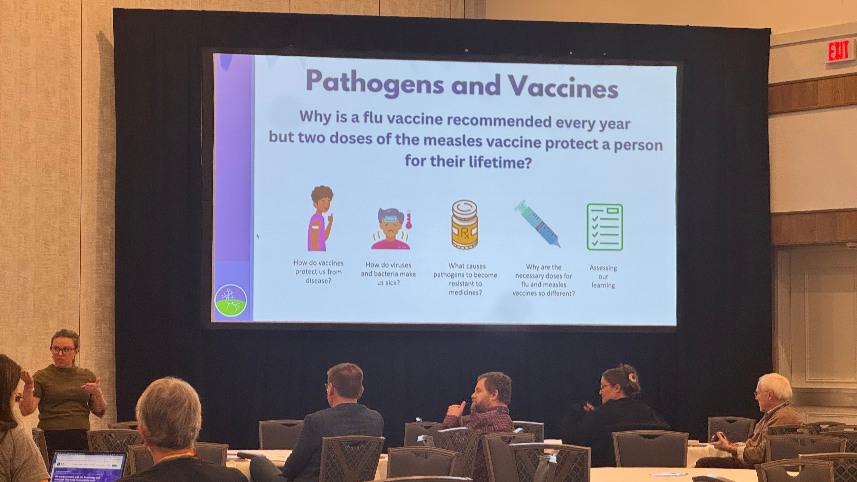
Science Education Specialists Britt Miller and Wendy Johnson led two other general conference sessions highlighting our free classroom resources. The first session reflected on the challenges teachers face when teaching evolution in K–12 classrooms, highlighting factors such as persistent misconceptions, misunderstandings about the nature of science, and perceived ideological conflicts that can complicate instruction. Educators were introduced to NCSE tools designed to meet these challenges, including the BRAVE framework and our Driving Question Boards, and explored how these supports can foster more productive, evidence-centered classroom discussions. Participants also examined NCSE’s newest evolution Story Short, “Pathogens and Vaccines,” which tackles the common misconception that “evolution happens too slowly to observe” by guiding students through an understanding of why a new flu vaccine is recommended each year, but the measles vaccine can potentially last a lifetime. In another session, teachers explored climate change resources and strategies for helping students navigate a range of emotional responses to climate science, from skepticism to anxiety.
NCSE hosted a three-hour pre-conference workshop supporting teachers in using the DataWISE tool. DataWISE is one of our newest resources and integrates data and media literacy with core scientific practices like analyzing data and evaluating evidence. During the workshop, teachers stepped into the role of learners to use the tool to critically evaluate data-based claims, some accurate, others quite misleading. Participants seemed to appreciate how the experience tied core science practices to a broader need to address mis- and disinformation in science. As one participant shared, “I love the DataWISE framework and how parts of it can be used independently, depending on what students are doing (e.g., evaluation of worthiness separate from data inspection).” Another teacher noted, “All the activities are useful and well designed. I will use this right away when I return to school.”
Finally, we were thrilled to celebrate our own Sound Science Fellow, Molly Selba, who received NABT’s Evolution Education Award this year. Selba’s longstanding commitment to expanding access to high-quality science education, through her work with underserved communities, her Human Evolution Teaching Materials Project, and her leadership in teacher professional learning, embodies the values of this award and the goals of the Sound Science Fellowship.
We are thankful for another opportunity to partner with NABT at its conference, sharing professional learning experiences and critical conversations about authentic science education. Even more so, we are continually grateful for the opportunity to be part of a community of educators who remain deeply committed to teaching accurate, evidence-based science.