The history of “intelligent design” up to 2005 is well-known: After a decisive defeat in the 1987 Supreme Court decision Edwards v. Aguillard, young-earth creationism was nonviable as a legal strategy for undermining the teaching of evolution in public schools. “Intelligent design” then emerged as a less overtly religious form of anti-evolutionism. Throughout the 1990s and early 2000s, books like Phillip Johnson’s Darwin on Trial, Michael Behe’s Darwin’s Black Box, and William Dembski’s Intelligent Design challenged evolution purely on philosophical and scientific grounds, eschewing any stance on the age of the earth or the historicity of Noah’s flood. Though scientists recognized their arguments as just a new gloss on standard creationist boilerplate, “intelligent design” proponents received respectful coverage in mainstream outlets, and their books were extensively reviewed in academic journals. But it all came to nought in 2005, when “intelligent design” suffered a crushing defeat in the trial in Kitzmiller v. Dover Area School District.
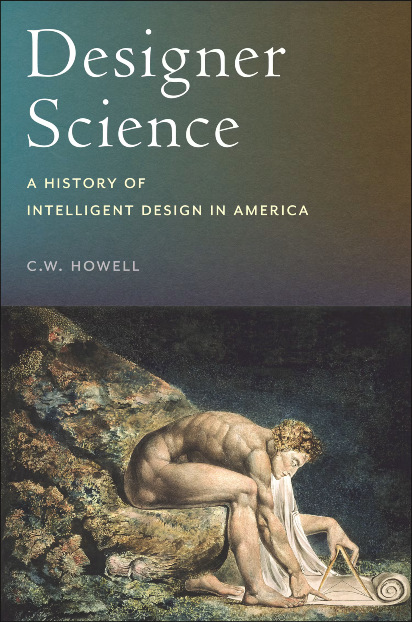 The history of “intelligent design” since that trial has received far less attention, and this is where C. W. Howell’s new book comes in. Howell holds a Ph.D. in Religion from Duke University and has written about science, religion, and technology for a variety of publications. The book’s first two chapters flesh out the history I just described. Chapter 3 then describes the relationship between evolution and political conservatism. Chapter 4 discusses the Dover trial and its aftermath up to the present. The fifth and final chapter discusses “intelligent design”’s relationship to a more general right-wing war on scientific expertise.
Howell’s book is thorough and competent, and he accurately presents the views of the main “intelligent design” proponents. He has performed a helpful service by presenting the recent history of “intelligent design” in an organized, coherent way. However, overall I found the book unsatisfying.
Howell devotes many pages to describing the main claims of “intelligent design” proponents, but he passes no judgment on whether those claims are correct. For example, Chapter 2 opens with several pages describing Philip Johnson’s assertion that acceptance of evolution requires a prior adherence to a fully naturalistic metaphysics. But this claim is flatly ridiculous. Evolution is no more based on naturalism than any other scientific theory, and it persists in scientific practice because it works very well when applied to practical problems. But Howell just accepts the framing that evolution versus design is fundamentally about metaphysical commitments and shows no awareness of the daily concerns of working scientists.
This problem persists throughout the book. For each of the topics he addresses, Howell writes many respectful pages telling us that “intelligent design” folks make claims x, y, and z. Indeed they do, but are those claims correct? Invariably they are not, but Howell makes no attempt to adjudicate anything.
In the book’s introduction, Howell, who describes himself as a theistic evolutionist, says he is writing as an historian and not a scientist, theologian, or philosopher. He writes, “[I] have no interest in promoting any particular viewpoint on creation, design, or theism” (page 15). But this will not do. If you are writing the history of, say, Russian science under Lysenko, then absolutely give a fair and sober presentation of Lysenko’s beliefs and motivations. But you cannot just leave out the part where he was wrong about important things. So it is here. When recounting the history of a pseudoscience like “intelligent design,” you simply cannot tell the story accurately without assessing the merits of their arguments.
Worse, when Howell allows the critics to speak at all, he frequently does not engage with their most substantive counterpoints. For example, in chapter 2, Howell describes Michael Behe’s arguments about “irreducible complexity.” Turning to the critics, Howell writes, “The evolutionary reply often took the tone of Mark Twain’s exasperated traveling companion in Roughing It, who — when his story of being chased up a tree by climbing a bison was doubted by his companions — exclaimed, `Because you never saw a thing done, is that any reason why it can’t be done?’” (p. 63). This gives the impression that Behe’s notion of irreducible complexity points to a real problem for evolution, just not one the critics think is sufficient for rejecting the theory. Biologists have offered comprehensive scientific rebuttals to Behe’s arguments, but Howell makes only the briefest mention of that fact.
These examples are characteristic of the entire book. As a result, Howell effectively has promoted a particular viewpoint. I think readers approaching the book from an evolutionary viewpoint will frequently find Howell’s account to be biased and frustrating. Understanding the cultural significance of “intelligent design” requires understanding their assertions and arguments, but it also requires understanding the reasons why scientists are so uniformly opposed to them. Howell does a good job of presenting the former, but not the latter.
Designer Science: A History of Intelligent Design in America
by C. W. Howell
NYU Press