The last 20 years have been a time of high emotions regarding the science of climate change and the need to respond to its effects. However, we have entered a new time, when no matter what you believe about the cause, the world is changing rapidly around you: storms, floods, fires, landslides. And more changes are starting to impact us: property loss, crop loss, new diseases. All of these things engender an emotional response, often a complicated one. When a forest burns, are we happy that natural processes are helping the forest adapt and heal, or devastated by the loss of property or a favorite place? Probably both.
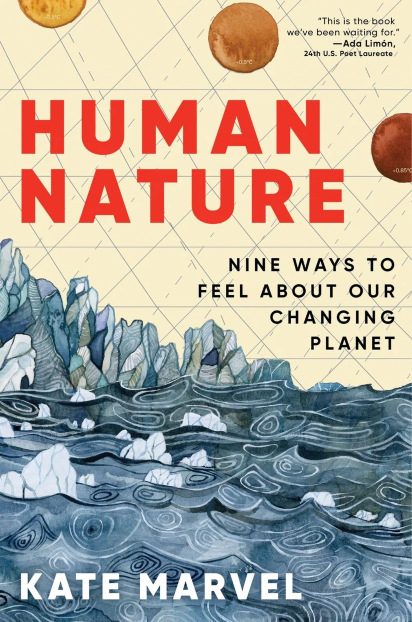 Kate Marvel’s book Human Nature is a tour through the science of climate change and its impacts, as well as the emotions they provoke. Rather than describing the emotions, each chapter, named for an emotion, conveys some of the science in a context and voice that provokes the emotion in the reader. It is a tour de force. Marvel, a climate scientist specializing in modeling, details the science with clarity that makes it easy to follow and context that makes it anything but dry. A particular strength is the way that she addresses uncertainty, helping you to understand not only when and why there is a scientific consensus but also the scale and source of uncertainties that remain. Her treatment of emotions is no less masterful, making you feel the fear as well as the hope deep in your heart.
The book begins with “Wonder,” describing the basics of the climate system with all of the awe that its complexity inspires. In an unusual turn, Marvel uses Greek mythology as context introducing modeling with the story of Cassandra, atmospheric circulation with Icarus, ocean circulation with Poseidon and more. The comparison of two very different ways of understanding the Earth helps us better understand the nature of science while making the science accessible and memorable. Chapter 2 is “Anger,” drawing on her experiences testifying before Congress. You can feel her pain. This chapter details the greenhouse effect and its role in climate while tackling many of the common misconceptions and arguments used by those who wish to misconstrue the science. Next comes “Guilt,” which looks at the causes of climate change, making very effective use of the historic context to illuminate how humans have responded to climate change in the past and assigned blame for the negative consequences. The common arguments that humans are not to blame are debunked one by one. “Fear” is a particularly challenging chapter to read, since it does a very effective job of describing the impacts to date, and the likely impacts in the future, while taking on the arguments that everything will be okay. “Grief” addresses perhaps one of the most prevalent emotions right now, as we struggle with what has been lost already. In this context, Marvel helps us understand the feedbacks that are a fundamental aspect of our complex climate system and why we can expect to lose much more. With that knowledge in hand, we are ready to understand where the future uncertainty really lies. “Surprise” discusses what we don’t yet know about the climate system. The chapters “Pride” and “Hope” change the tone of the book — and thank goodness, because you will be pretty depressed by now! “Pride” and “Hope” show how humans have in the past managed collectively to change course, often quickly. These chapters describe what must be done and why. The final chapter, “Love,” leaves science behind and ends the book on our humanness, using her own life and her work with climate models in a final discussion of human nature.
My only regret is that Marvel doesn’t take on respect. I thought she would end the book with the idea that the complex Earth system that she describes so well will always surprise us, giving and taking things away in complicated ways. That while we can change it, we are not likely to control it before we go extinct. And that like all life that inhabits it, the Earth is worthy of tremendous respect and love that should inspire humility and temper hubris in our actions.
However, this is a personal book from beginning to end, and Marvel chooses a powerful, personal conclusion. She ends the book as she began, speaking to the reader as a fellow human, and sharing the emotions she, a scientist, feels.
I recommend this book for scientist and layperson alike. The science is put forward in ways that make it understandable. For those already familiar with the science, the context tells the long story of changes in the environment having very real political consequences, which you may not know so well. For all, Human Nature legitimizes the conflicting emotions we are feeling about climate change and its impacts. It is a masterpiece for you to enjoy.
Human Nature: Nine Ways to Feel about Our Changing Planet
by Kate Marvel
Ecco