[Review] The Hundred Years’ Trial: Law, Evolution, and the Long Shadow of Scopes v. Tennessee
"The Hundred Years’ Trial belongs on the shelf of not only those interested in deepening their knowledge about Scopes, but also anyone interested in the long history of battles in the courts between citizen groups that are pro or anti science," our reviewer writes.
Among the many good books on the 1925 trial of John T. Scopes, who was accused of teaching evolution when a Tennessee statute prohibited it, The Hundred Years’ Trial stands apart. For one thing, the authors — a father-and-son team — provide expertise in both law and biology. Alexander Gouzoules is a professor of law at the University of Missouri School of Law, while his father Harold Gouzoules is an evolutionary biologist and professor of psychology at Emory University. This unique pairing of expertise enables the authors to weave into a single and clear narrative how, over the century since the Scopes trial, continuing developments in biology and in law have interrelated. For another, the book’s main contributions are not centered on the Scopes trial itself, but instead use it as a springboard into all the developments at the intersection of law and evolution (there are quite a lot, it turns out) that have happened since.
 At the broadest level, the authors believe that a close examination of Scopes and its long aftermath “offer lessons for other significant, complex, and contentious issues” (page 234). On this implicit promise, they amply deliver. The authors make a compelling case for the continuing relevance of the fundamental clash between supernatural and natural accounts of human origins that Scopes embodied, not only because anti-evolution groups continue to adapt their tactics to the shifting legal landscape (which now includes a potentially sympathetic U.S. Supreme Court), but also because very large swaths of the U.S. citizenry have an increasingly fraught, and often distrustful, view of science.
At the more granular level, the authors present many hidden gems, including a plethora of lesser-known facts. I had no idea, for instance, that Bryan College — a religious institution that was named after the lead figure in the Scopes prosecution, William Jennings Bryan, and which is not far from the Scopes trial courthouse — conducted a Bible Education Ministry in the public schools of Rhea county for more than 75 years after Scopes, through 2002. Nor was I aware that in 2005 a federal judge had written into his judicial opinion — with neither citation nor accuracy — the astonishingly wrong assertion that Darwin believed whites had evolved from chimpanzees, while Asians and blacks had separately evolved from orangutans and gorillas, respectively. Nor did I know that there had been a proposed referendum in New Jersey in 2010 (ultimately struck down by an administrative law judge) “that the theory of evolution is racist and communistic.”
On the biology side, The Hundred Years’ Trial provides a wonderfully clear and succinct tour of the origin of the Modern Synthesis in biology. It illustrates how at the time of Scopes natural selection was considered to be on weaker footing than it later came to be, once the Synthesis merged the understandings of natural selection and modern genetics (among other fields). Showing how biology can become entangled with politics, the authors also demonstrate how various debates within evolutionary biology are often misconstrued and misrepresented by those seeking to curtail, contract, or counteract the teaching of evolution, as if those debates presented challenges to the basic Darwinian insights. Along the way, the book graphically traces the common pattern, by critics of evolution, of trying to bind Darwin’s ideas to those who mischaracterized or misused them.
For those readers not intimately familiar with legal landscapes, the authors provide a thoughtful, useful, and accessible tour of how different courts have dealt with varying kinds of anti-evolution laws, and how the weaponry of legal theories has shifted over time. After prohibiting the teaching of evolution on religious grounds was defeated in the courts, anti-evolution campaigns instead focused on requiring balanced treatment of evolution and creationism, or rooting the teaching of creationism in principles of free speech, the academic freedom of teachers, and the like. The authors are particularly adept at recounting — often with astute commentary — the fascinating twists and turns by which various different legal strategies for either reducing instruction in evolution or increasing a countering instruction in creationist theories on the origins of mankind appeared under the banners of creation science, “intelligent design,” “teach the controversy,” and more. The irony, of course, is how the very efforts to prohibit the notion that adaptations arise from selection pressures themselves adapt to the selection pressures created as the courts repeatedly eliminate un(re)productive arguments.
The Hundred Years’ Trial is remarkably up to date. The authors explain how and why, after the U.S. Supreme Court in 2021 rejected its own precedent of Lemon v. Kurtzman, which had set the test by which excessive government entanglement with religion had long been identified, and by which many evolution/religion disputes had been decided, “[t]he law undergirding the teaching of evolution in the US schools now sits on a far less stable foundation" (page 224). The authors go on to offer some reasonable projections about future U.S. Supreme Court decisions on the teaching of evolution, in light of its recent rulings regarding abortion, gun control, public funding of private religious schools, and the like.
In my view, The Hundred Years’ Trial belongs on the shelf of not only those interested in deepening their knowledge about Scopes, but also anyone interested in the long history of battles in the courts between citizen groups that are pro or anti science. It is well-written — often graceful, careful, detailed, and meticulous — as well as consistently engaging. And even technical issues of law and biology are quite lucidly explained in a way equally accessible to laypeople and specialists alike. The authors have combined their complementary expertise to skillfully present the people, personalities, and developments behind the courtroom battles and judicial decisions.
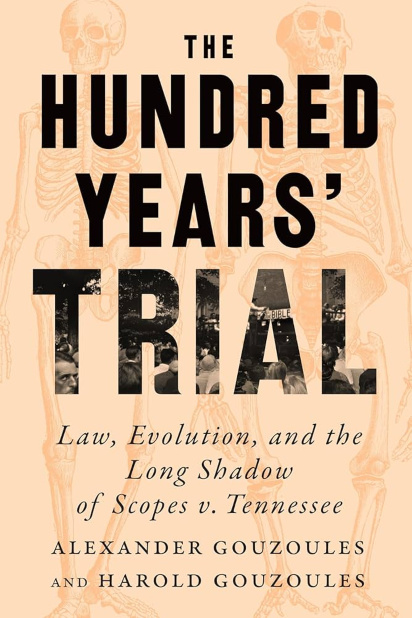
The Hundred Years’ Trial: Law, Evolution, and the Long Shadow of Scopes v. Tennessee
Alexander Gouzoules and Harold Gouzoules
Johns Hopkins University Press

Owen D. Jones is both a professor of law and a professor of biological sciences at Vanderbilt University. He is the author of Force of Nature: Understanding Evolution’s Deepest Logic — and Putting it to Use (W. W. Norton and Oxford University Press, 2026).