[Review] Humans: Perspectives on Our Evolution from World Experts
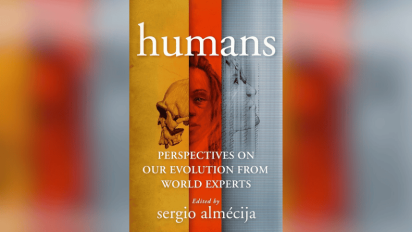
"Humans is an engaging book filled with the thoughtful musings of many of the top minds in anthropology, packed with endless insights and ideas," our reviewer writes.
Humans is not your typical popular science book about human evolution. For one thing, you will not find the grand narratives and romantic speculations that so often imbue books on this subject (admittedly including my own). You will not find bold hypotheses, scant of evidence, for the origins of human nature, the emergence of our unique intellect, or the development of social stratification. And you will certainly not be subjected to the haughty pontifications of the author, brazenly interpreting all evidence in accordance with his particular anthropological perspective. In fact, you won’t hear much from the author at all!
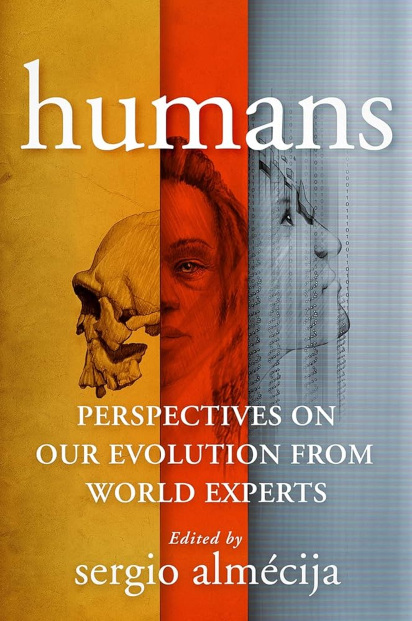 Instead, Humans is a book of thoughtful contemplation. Sergio Almécija, a biological anthropologist currently at the American Museum of Natural History, has assembled more than one hundred of the top scientists who spend their days and nights actively working on the countless unanswered questions about the origin of our species, and asked them to step outside their narrow research questions and consider what we know, or think we know, about human evolution.
The book contains interviews of a sort, in which Almécija presents a variety of questions that challenge these scientists to explain their unique research perspective and to wax philosophical about the larger questions in the field, to which their own contributions may be only tangentially related. Among the questions are items like, What fact about humans amazes you the most? and What factors set our ancestors on the path to becoming human? as well as more personal items such as When and why did you decide to do what you do? and What discovery do you most consider a “game changer”? And there are some more speculative ones as well, such as Where would you go if you had a time machine? and How will humans evolve in the future?
The researchers chose which questions to answer. To my surprise, they often elected to address issues quite removed from their typical sphere. I think this speaks to how we scientists often relish opportunities to wrestle with puzzling issues apart from those that usually consume us. In a field not known for its humility, I was delighted to see giants of paleoanthropology step back and say, “Gee, I really don’t have any idea how this might have happened.” I was also stunned to read some of these scientists expressing open skepticism of received wisdom, vaunted ideas, and prevailing theories.
Because it pulls back the curtain on how leading scientists really think about each other’s ideas, Humans is ideal for students and teachers of human evolution, and anyone interested in coming to grips with the field. It illuminates the reality that knowledge is tentative and dogma is fragile. No one gets the last word.
It took me a minute to realize how best to engage with this book (odd, since I was one of the anonymous peer reviewers of the book proposal), so let me save you some time. Most importantly, this book is not meant to be consumed in a linear fashion. You needn’t simply sit down and start reading, beginning to end. Instead, feel free to leaf through the various entries in whatever order you want. Yes, the book is loosely organized into sections covering specific geological eras when major evolutionary transitions occurred, for example, the origin and diversification of apes, the roots of the Homo genus, and so forth. But within each entry, the contributors offer their unrestricted ruminations on anything and everything in the field, from the mismatch of our modern and our ancestral diets to what a future extraterrestrial human population might look like. I recommend consuming this book in bite-size bouts of time, skipping around randomly or seeking out a specific researcher whose thoughts interest you on a given day.
In fact, perhaps the best way to utilize this book is as a resource to hear more from an author whose book or article you are currently reading. Whenever Nina Jablonski is in the news, or Frans de Waal publishes a new book, or Yohannes Haile-Selassie presents a new fossil, you can grab this book, flip to their entry, and gain insightful context about them. I did this twice in the month I was working on this review, once when reading an article by Susana Carvalho and her colleagues about chimpanzee social networks, and once as I read Determined by Robert Sapolsky. In both cases, the work instantly became more personal, more intimate even, and I got a glimpse of how these two scientists think about their work, even though I have never met them. As such, this book serves more like a reference text than a popular science book, but the reference material isn’t established knowledge, but rather the unprocessed thoughts and ideas of the scientists in this field.
In sum, Humans is an engaging book filled with the thoughtful musings of many of the top minds in anthropology, packed with endless insights and ideas. Whether you are a layperson, a scientist in another area, or even a veteran paleoanthropologist yourself, you will learn a great deal from this book, and broaden your perspective. You will even encounter opinions and conclusions that you disagree with — indeed there are direct disagreements among the contributors! — and you may find your own preconceived notions unsettled. In my opinion, that is a defining feature of a good book.
Nathan Lents is Professor of Biology at John Jay College of Criminal Justice. His most recent book is Human Errors: A Panorama of Our Defects, from Broken Genes to Pointless Bones (2018).